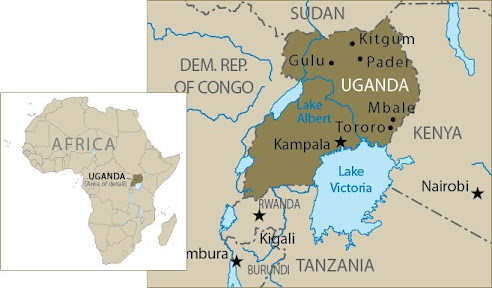
Map of Uganda

Map of Uganda
The Uganda Kampala Mission includes Uganda, Ethiopia, Rwanda, Burundi and Southern Sudan. Our assignment covers all the areas except Ethiopia.

Sunday, July 19, 2009

A NEW PROJECT IN ENTEBBE ???


On the banks of beautiful Lake Victoria there are many poor fishing villages. In one such village we found the Lakeside Preparatory School. Like hundreds of other schools we have seen here it has many more needs than we could possibly meet. What we saw there are scenes that are repeated all over Uganda, every day. The conditions at this school are worse than some; better than others.


We are going to try to put a rain water catchment system on the school but will have to slope the roof to one side first.


There are 458 children in the school and 3 teachers. This classroom holds 80 children and the firewood supply for cooking.


Elaine always spends time letting the kids practice their counting in English.


Art gets to just play around with the kids during lunch time.


For lunch, each child has to bring a cup of maize flour from home so porridge can be made.


Those who don’t have flour don’t get porridge and have to find sugar cane or a mango to eat, from the nearby forest.


One of the big needs here with growing children is shoes. Most of the children are bare footed all of the time. This is a school where many cannot afford the uniforms. We are trying to get permission to seal dirt floors with a thin plaster coating to prevent diseases and parasites.


Some of our good friends from the U.S. have sent children’s books, which are received with joy at the schools. Books of any kind are a novelty in schools here. Most of the teaching is done by repeating back, in unison, what the teacher has said. They lack any writing materials.


In spite of circumstances as we see them, the children are always happy and friendly and like to lead us around by the hands.


For the 458 children there are 2 pit latrines and 2 open air urinals. These pose a serious health hazard and we are going to try to get approval to build new concrete latrines at this school.


The school’s “kitchen” also needs some work. We have plans for an adobe brick stove which we can build that uses very little wood and vents the smoke outside.


As we left, we were struck by the contrast of the forest just beside the school. There is much to be done here…

Monday, July 13, 2009

LATEST CRISIS IN UGANDA...

The following article appeared in yesterday's newspapers. Soroti and Amuria are where we took tools and seeds for planting in May. Unfortunately, it has not rained there since then. We are meeting with Cabinet Ministers tomorrow to see what we can do. The Emergency container we had ordered for the refugee camp just arrived here Friday but contains no food items. We will have to see what tomorrow brings...

Two million people at risk of starvation in Uganda

THE NEW VISION | BUKEDDE | ORUMURI | RUPINY | ETOP | SUNDAY VISION | BUKEDDE KU SSANDE

Saturday, 11th July, 2009

BY HERBERT SSEMPOGO


OVER two million people in North, Eastern and West Nile are at risk of starvation, the Uganda Red Cross has announced.

The agency yesterday stated that Kitgum, Katakwi, Bukedea, Kumi, Soroti, Amuria, Koboko, Adjumani, Nebbi, Arua and parts of Kibaale are the worst hit areas.

Michael Nataka, the Uganda Red Cross secretary general, yesterday attributed the famine to prolonged draught, out of season planting, the ripple effect of the 2007 floods that ravaged Eastern Uganda and changes in weather patterns. The statement follows an evaluation tour of the affected areas.

“In some areas where farmers planted early, the crops were thriving. But you find in the same village crops are withering in other gardens because people planted late,” Nataka stated.

“The region has never recovered from the flooding, which affected the cycle of storing seeds. There is also lack of adequate information about the weather. People are relying on seasons that have since changed.”

Children, elderly, sick and the children-headed households are the worst hit individuals, according to Nataka.

The Red Cross, however, noted that all of the deaths recorded in the affected areas were not as a direct result of hunger. For example, in Adwari, Lira district six people who succumbed to HIV/AIDS and another four who died of old age had been attributed to hunger.

Accordingly, the agency has launched an emergency appeal for sh5.6bn to feed 50,000 people. The Red Cross plans to raise 3030 metric tons of food to provide relief in the hunger-stricken areas. Well-wishers may deposit monies on Standard Chartered Bank account number 0108213406906 while others may contribute food in kind.

URCS, he added, had provided its store in Ntinda, a city suburb where the donations in kind would be stored before dispatch. Deputy Secretary General, Dr. Bildard Baguma said that they would first focus on the worst hit areas before rolling out to other areas.

HEADLINES
NBS The Web


Politicians start games about the hunger in Teso region.

The saga surrounding the supply of food to hunger victims in Teso sub-region has taken a new twist. Politicians are now sounding drums of verbal exchanges over their own failure to address the situation.

Sunday, June 28, 2009

HEALTH INITIATIVES IN RWANDA AND UGANDA

We have just completed the process of organizing the Neo-natal resuscitation project which will take place in Rwanda in January 2010. Dr.Petty, an anesthesiologist, and his wife came from Cedar City, Utah to get things organized. For short-term specialist in their 70s, they were a couple of fireballs. There were a number of obstacles to overcome when we first went to Rwanda. We visited the office of the UNHCR in Kigali and found that the woman in charge had previously worked on a NRT program in Angola with the Pettys. She spent some time making phone calls to friends in the government and by noon all of the necessary doors had been opened for meetings with the Minister of Health, the U.S. Embassy,USAID and the necessary hospitals.


Art and Dr. Petty meeting, at the University Hospital in Kigali, with the Chief of Obstetrics and the hospital's pediatrician.

We found this though provoking poster in the office of the United Nations High Commission for Refugees. It was especially meaningful to us after our experiences in Southern Sudan and the refugee camps in Uganda.

Elaine with the Chief of Nursing for the Ministry of Health and one of the Head Instructors for the School of Nursing in Kigali.

There are many reminders in Rwanda of the 1994 genocide. This is the Parliament building in Kigali where the last battle was fought at the end of the genocide. Note the bullet marks around the top walls of the building.

While we were there, we also made arrangements with the UNHCR to go with them in September to the refugee camps in Rwanda to help distribute the shipment of 11 relief containers the Church is sending from Salt Lake City. There are currently 53,000 refugees from the DR Congo in three camps in Rwanda.

COUNTRY WIDE VACCINATION PROGRAM IN UGANDA

When we returned to Uganda the Church participated with the World Health Organization in a measles and polio inoculation program which vaccinated 5.5 million children, below the age of five, throughout the country. Members acted as volunteers at some of the 1500 vaccination posts (including those under trees).

The full time missionaries helped cheer up the kids and got to practice their Lugandan language skills.

Elaine, of course, brought her usual supply of balloons and candy.

There are many misconceptions and superstitions in Uganda about vaccinations. Sometimes the volunteers had to go house to house encouraging the parents to bring the children for shots.

Here a member of our Branch in Mengo comforts a little girl after "the big event".


We went to check on one of the orphanages to see if they had received the vaccinations and ran into a girl's soccer team from Provo, Utah. They were in Uganda teaching girls to play soccer. Here it is exclusively a boy's sport.It was quite a surprise meeting them. They were travelling around Uganda for two weeks doing clinics.

By the end of the four day drive, 520 of the members of the Church in Kampala and Jinja donated a total of 7,150 hours at the schools and vaccination stations. We had an interesting experience with the 27 members of our Mengo Branch who worked a total of 970 hours. On the first day, the Red Cross van took them 6 miles out to various stations in a very depressed area of the city and left them with the promise that they would be back. Unfortunately, they did not go back to pick them up after dark. None of them had the 50 cents necessary to ride a Boda-Boda home. They did have cell phones, so they met up and walked the 6 miles home, arriving at 10:30 P.M. The next day at church they told us that they had been "disappointed" by the way they were left by the Red Cross but that what they were doing was important for the children. That afternoon and the next day they all went back to the same area to continue working. We gave them money for transport in case they were left again. The Ugandans are kind-hearted people who share with others regardless of how little they have themselves. We are always touched by their kindness.

Sunday, June 21, 2009

Ribbon Cutting Ceremony....almost!

The villagers are all gathered for the ribbon cutting ceremony to lauch the pineapple project, the cameras are rolling, the scissors are sharpened....razor sharp! As they say; the rest is history. At least we didn't have to listen to long boring speeches. (It takes a minute to load)

Thursday, June 11, 2009

Humanitarian Projects in Rwanda

We will be in Rwanda again next week for six days to help get details worked out for the neo-natal resuscitation training program that the Church will conduct in November. Physicians and nurses from the United States will come to conduct training classes for the medical personnel in Rwanda. In all, 200 physicians, nurses and nurse midwives will receive the training. During this trip we will meet with Rwanda’s Minister of Health and other government officials to solicit their approval and support for the program.

While there, we will visit the refugee camp where there are 53,000 refugees from the war in the DR Congo. The Church is sending 10 containers of emergency supplies which should arrive in the next 30 days. We will go back then to assist with the distribution. This trip we are there to just assess logistics and the areas of greatest need.

Sunday, May 31, 2009

COMPLETION OF PINEAPPLE PROJECT

We have been working with a man named John Galiwango on this project for several months. The Church is funding the start-up of a pineapple plantation in the remote rural village of Kigayaza, near Mukono, Uganda. This is an area where most of the people are subsistence farmers with little actual income. The village had a 3.5 acre tract of community land which they cleared and cultivated. We supplied the machetes, hoes and fencing materials to clear the land and spray for weed and insects. When it was ready for planting, we purchased 30,000 pineapple suckers and 250 banana suckers. The project will be used to train the villagers in planting methods, crop management and pest control. As the pineapple plants grow, some of the suckers will be removed and given to other villagers to start their own smaller crops. The banana plants will mature faster and provide an additional cash crop. It will take the pineapples 18 months to be ready to harvest. The banana and pineapple crops will provide income for school fees and needed items for the villagers.


When we first visited the site the 3.5 acres was covered with dense forest. John told us that 30 men working together could clear the land with just machetes and hoes. When we asked how long that would take them he told us 3 weeks. We were slightly skeptical that it could be done that quickly.


When we returned 4 weeks later, this is what we found. The field had been cleared and the suckers planted. The people here can do an unbelievable amount of work with just a hoe. They are hard working and dedicated. There was still work to be done but we were certainly impressed by what they had accomplished in so short a period of time.


We provided some wheelbarrows to help with the field preparation. Coffee husks are spread to fertilize and keep down weeds. This is Ssimbwa, Elaine and John on the day we purchased the wheelbarrows. Elaine is providing the "nutritious" energy food for the workers.


Shortly, the field had all weeds removed and an additional maize crop planted to be harvested while the plants are growing. It will take 18 months for the pineapples to mature so the bananas and maize can be grown as cash crops during that time.


There is a shallow well pump near the field which can help with irrigation during the dry months. However, it sometimes goes dry before the rains start. We also supplied two 2,000 liter storage tanks which can be filled and saved for reserve water during this time.


While we “sweated” with installing the tanks, Elaine entertained John’s children. She obviously got the better part of that deal.


This is another project which John worked on previously in a different area. The pineapples are almost ready to harvest. We are sure this current project will do well and provide needed income for the people of the Kigayaza village.

Saturday, May 2, 2009

EMERGENCY AID TO NORTHERN UGANDA

The day we left Kampala headed for Northern Uganda with 2,400 hoes, 13,500 lbs. of cow peas and 330 sacks of cassava cuttings, the local paper had this headline: “Biting hunger has reduced Teso region to ghostland.” Northern Uganda, already suffering from the effects of a prolonged drought was heavily damaged by widespread hailstorms that destroyed crops, collapsed school buildings and huts, injured people and killed livestock. We were contacted by Musa Ecweru, Uganda’s Minister of State for Disaster, Emergency Relief and Refugees, requesting our help. We have worked with him before in the Congolese refugee camps in southern Uganda. He told us that people in Northern Uganda had been reduced to scavenging in the forest for leaves to eat. We contacted the Area office in Johannesburg, South Africa and within a week had approval to proceed and had arranged the supplies for transport. Cow peas are used here because within 3 weeks of planting there is a vine so that some of the leaves can be eaten. Three weeks later there are edible pods, followed by mature peas in another three weeks.

Our project assistant, Ssimbwa Busulwa had all of the needed items located and reserved by the time we got approval for the project.


Here he is with Minister of State Musa Ecweru during our planning session over lunch.

When we got to the villages we found that most of the remaining crops had been destroyed by the hail storms. Some of the fields had been cleared but there were not enough hoes to cultivate and no seeds for planting.


We were grateful for the speed at which the Church can operate where there is an emergency. Most of the other organizations were still in the process of conducting “baseline surveys.” Minister Ecweru called for all humanitarian organizations in Northern Uganda to cancel any seminars or workshops and “get to work helping”. He said, “We should not be holding meetings while people are starving.” The hoes and seed were much needed items. We also provided sacks of cassava cuttings, as cassava produces more crops per acre than any other crop in Uganda.

At each village that we had designated as a distribution point there were nearly 1,000 people anxiously waiting to receive the supplies. Here, Elaine commented about the strong and very calloused hands the women had from a life time of hard work. Minister Ecweru is a very dynamic speaker and tried to lighten the situation by using humor wherever we went. In 2004 he led the army which drove the LRA from this part of Uganda and is greatly loved and respected in the area.

Of course, there was the usual supply of beautiful babies to hold.


This school had been heavily damaged along with a medical clinic and numerous huts. The damage appeared more like a tornado than hail. The roofs had been blown off of many of the buildings and water tanks destroyed.

This building collapsed during school hours, killing one girl and seriously injuring six other students.

The UN loaned us trucks to help deliver the supplies to the four main distribution points and people gathered from the surrounding areas. The people would run through the fields to meet the trucks as they arrived.


We were impressed by the way people helped each other even though they were in a desperate situation themselves. This older lady arrived after all the seed had been given out at this distribution point. The young woman with the baby beside her was from a different village but she divided her seed and gave half to her to plant.

Although this man was very old and feeble, we found him a hoe and seed because he said he could get a young boy to plant his garden in return for borrowing the hoe to plant his own.

We saw many powerful examples of the honesty and integrity of Ugandans even in these dire circumstances. The women would work for an hour picking up every single seed which had been dropped so that they would have more for planting...


Yet, one of the 220 pound bags of seed fell off a truck and lay for two hours on the ground while seed was being handed out under the nearby tree. Although they could have easily done so, no one disturbed or broke open the bag until it was time for it to be distributed.

After everything was distributed and we were returning to town, we noticed that every mango tree we passed had people in it picking fruit. The Tamarind trees had all the leaves stripped off for food as high as you could reach. There were World Food Program trucks coming from town, with flour to meet the immediate need until the crops grow. It was starting to rain and we felt thankful for what the Church had been able to do.

When they ran a story on the evening news about the project, they referred to Art as “The owner of The Church of Jesus Christ of Latter-Day Saints”. We thought that was rather humorous.
"Everything must have a beginning"

"Everything must have a beginning"
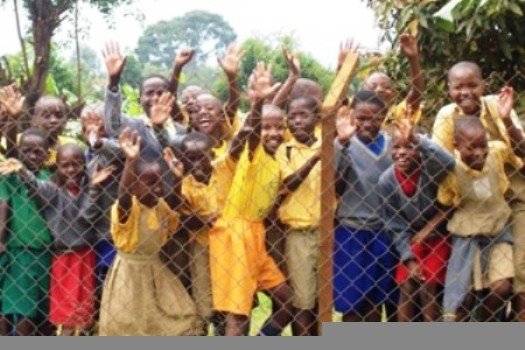
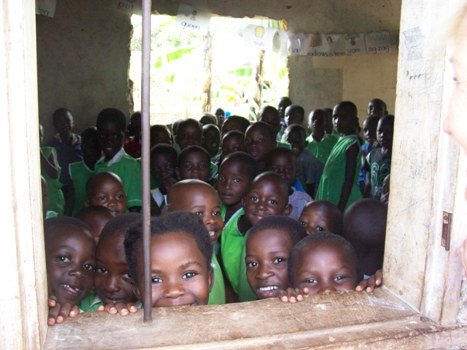
Children at an orphanage in Entebbe, Uganda. There are so many children here it is incredible; there are orphans everywhere. The people take them in and it is not unusual to see families struggling with 8-10 children. We talked to a woman yesterday who has taken in twelve children. She said, "sometimes I feel sad that I cannot do more, but everything must have a beginning". We have decided to use that as our personal reminder to guide our actions here as we try to help.